
In 1994, I attended a lecture at The College of William and Mary. The speaker mentioned Sarah Parker Remond (a 19th century African American abolitionist)! I had never heard of her and so down the rabbit hole I went. I began by reading every book and article I could find about her.

Then, I traveled to London and conducted research at the British Newspaper Archives and then at the Royal Holloway Archives and Special Collections, at the University of London. After that, I gave talks about my research, at various conferences. Those talks turned into publications and helped me to get early tenure, as an academic librarian.

Sarah’s father, John Remond (1788-1874), was from Curaçao. At around the age of ten, he boarded a ship and made it all the way to Massachusetts, He found work. Later, he married and had children. As soon as I read about him, I knew that someday I would visit Curaçao.

Well, thirty years later, I traveled from Panama City to Willemstad. The city is well known for its beaches and colorful colonial architecture. In 1997 Willemstad received its UNESCO World Heritage designation. I booked an AirBnB, in the old quarter of Otrobanda. From my front door step, I was surrounded by brightly painted colonial buildings, statues, and street art. I had a mere three minute walk to the waterfront.

To learn about the city, I booked a tour. I paid $20.00, at a stand setup on the other side of the Queen Emma Bridge. The cost of the tour was half the price of the those I had seen online. I was probably the only person not off a cruise ship. These types of land excursions are perfect for visitors with a limited amount of time.

Our adventure included a tour of historic neighborhoods, including Curaçao’s old Jewish community (from 1634), a stop for a liqueur tasting, and two hours at Mambo Beach. Afterwards, the cruise passengers were dropped off at their dock and I was dropped by Rif Fort and saw my first Chichi statue.

The Kura Hulanda Museum was a short walk from my AirBnB. Many tourists simply refer to it as the slavery museum. Located near the harbor, visitors can learn about the island’s role in the slave trade, steps away from where the Dutch traded Africans.
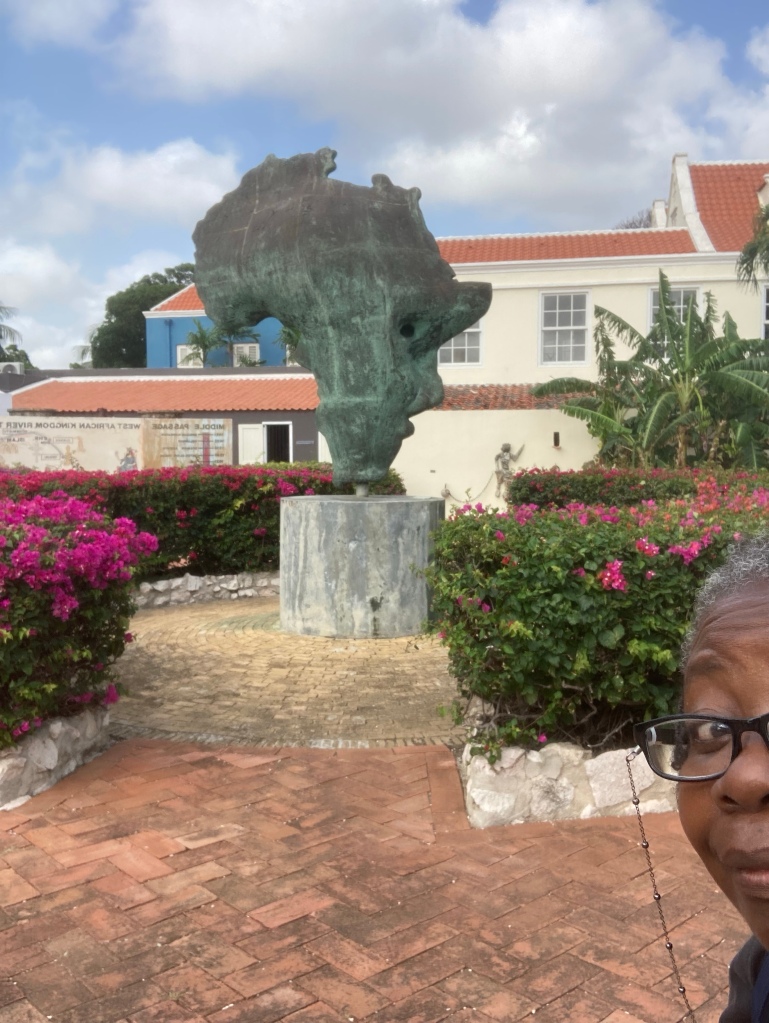
Forty per cent of enslaved Africans were shipped to the Caribbean Islands. For many, Curaçao was the first stop. Those arriving ill were quarantined on Klein island, now a favorite beach destination. The museum highlights the island’s role in the trade. After paying a small fee ($12) you can hire a guide ($2) or use the printed map to your way around the site.

Towards the end of my stay, I walked to the slave rebellion monument. It took around thirty minutes, on a very hot day. When I arrived at the turn for the beach, I knew that I was close. Along with the main statue, there were other art pieces on display. I made note of the totem pole and the fist.

Curaçao was everything I had hoped for and more. After spending years, researching, writing, and presenting papers, on Sarah Parker Remond, I finally made it to her father’s homeland. In the USA, we spend so much time and effort on hiding our slave past. For example, Florida’s new history standards.

The first slave ship, the “Bontekoe,” entered the St. Annabaai (St. Anna Bay) with 191 Africans on board, in 1657. Curaçao does not hide from that fact or the island’s role in the Trans Atlantic Slave Trade.
I will be forever grateful for spending time in a community preserving rather than hiding from its past. XOXO — GGT
 Ghetto Girl Travels Blog